Where the Tracks Meet the Tide: San Clemente’s Scenic Views and Fragile Tracks
- Joel Beers

- Jan 12
- 9 min read
From century-old homes to cliffside landslides, the small beach town offers unrivaled coastal views – but reaching them by train is increasingly a test of patience at Orange County's southernmost Metrolink stop.
This story is a part of our series OC by Metrolink, discovering what makes each stop worth the stop.

It began as a dream that quickly went bust. While San Clemente has recovered admirably and is celebrating its 100th anniversary this year, for anyone trying to reach it – or pass through it – by rail, the journey has increasingly become a nightmare. Coastal erosion, fueled in part by drainage from the homes perched atop the bluffs, has triggered a series of landslides in recent years. Coupled with massive construction to stabilize the cliffs, the result has been repeated track closures, forcing Metrolink and Amtrak to suspend service between San Juan Capistrano and Oceanside for weeks – sometimes months – at a time.
But when the coast is clear and the trains are running, San Clemente’s two stations offer the best views and access to the choicest recreational opportunities of any stop in Orange County.
Yes, you read that right. San Clemente – the second-smallest city by population among the 10 served by Metrolink’s OC Line (only San Juan Capistrano is smaller) and the third smallest by area (after San Juan Capistrano and Tustin) – has two train stations. They sit just 1.2 miles apart along the coast, and about two miles apart via PCH through downtown.
Neither station – the northern North Beach stop served by Metrolink nor the San Clemente Pier station served daily by Amtrak and on weekends by Metrolink – offers much in the way of size or amenities. But nearly everything worth seeing or doing in the city lies between them, and each station is literally steps from sand and surf. Add the fact that PCH does not run along the shoreline here, and San Clemente – along with Seal Beach – retains one of the county’s last true small beach-town vibes. (Dana Point is also set back from PCH, but its luxury resorts give it a very different feel.)
Relaxed and unhurried, San Clemente lacks Laguna’s artsy buzz and the high-end dining and nightlife of Newport or Huntington Beach. Still, there’s plenty to do in the self-styled Spanish Village by the Sea.

Complicated History

San Clemente’s first rail station, near the current North Beach station, opened in 1931, six years after city founder Ole Hanson – a former Seattle mayor best known for crushing the first general strike in U.S. history in 1919 before touring the lecture circuit to denounce Bolshevism – began selling housing lots in what would become one of the country’s earliest master-planned communities. Like everything built in those early years, from homes to the nearly 1,300-foot pier, the station adhered to Hanson’s strict Spanish Colonial Revival architecture: white stucco, red tile roofs, and arched forms – a look many of the city’s signature structures still embody today.
By 1932, however, the Great Depression had derailed Hanson’s dream; development ground to a halt, and many residents, including Hanson, went bankrupt. The city’s population dropped 60 percent in a decade. The train station lasted until around 1940, after which trains stopped in San Clemente only by request for decades.
When Amtrak took over rail service in the 1970s, a small station was built near the San Clemente Pier and in 1995, Metrolink opened a larger station at North Beach. Weekend Metrolink trains soon began stopping at the Pier, creating the unusual situation – still true today – of a small coastal city with two stations just over a mile apart. Amtrak’s Pacific Surfliner now serves the Pier daily, while Metrolink handles weekday commuter service at North Beach and weekends at the Pier. Persistent coastal erosion and bluff failures have repeatedly disrupted both, making San Clemente one of Southern California’s most scenic – and most fragile – rail corridors.

The most recent major landslide, in April 2025, closed the tracks for nearly two months as the Orange County Transportation Authority embarked on a $300 million stabilization project that included 5,900 tons of large boulders (riprap) to absorb flowing water, about 240,000 cubic yards of sand and a 1,400-foot-long wall at Mariposa Point, between the two stations. The short-term goal is to stabilize the coastal alignment against bluff erosion, landslides and slope failures that have forced repeated closures. Time is tight: A surge of rail passengers is expected for the 2028 Summer Olympics surfing competition at Trestles Beach, about three miles south of the pier.
Long-term, though, shoring up the coast with sand, rock and walls may not be sustainable. An inland reroute along the I-5 is under early discussion among a tangle of city, county and state agencies, along with freight operators – but it would take years and billions to deliver.


San Clemente North Station. PHOTO 1: The entrance to the platform is a simple awning off of the parking lot. PHOTO 2: Beach access is located a few steps east of the station. Photo by Joel Beers, Culture OC
San Clemente North Station
This is a small commuter stop where the tracks nearly touch the sand, allowing a straight walk from the parking lot onto the beach. Amenities are basic: bike racks, parking, passenger phones, benches and shade, but no major concessions on site.
Two notable buildings near the station, Ole Hanson’s Beach Club with its Olympic-size swimming pool and the Casino at San Clemente, an event hall, are closed to the public. Dining options nearby include the Beach Hut Deli and Moulin, a French café with outdoor seating and ocean views.
The big news on the culinary front, however, is the conversion of the former Miramar Theater, a 1938 Spanish Colonial Revival building, into the Miramar Food Hall, slated to open this year. Previously a seasonal farmers’ market pop-up, it will house about a dozen tenants, from local concepts like It’s Allll Rice][ to cafés, bars, and other stalls.

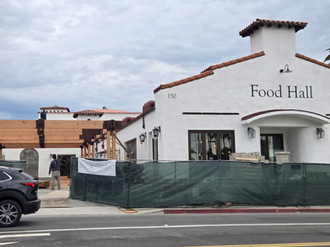


Near the San Clemente North Station. PHOTO 1: The Miramar Food Hall, slated to open this year. PHOTO 2: The French cafe Moulin offers ocean-view dining near the station. PHOTO 3: The Beach Hut Deli. PHOTO 4: Bicycles San Clemente where you can rent bikes. Surfboard and boogie boards can be rented near the pier train station. Photos by Joel Beers, Culture OC
San Clemente Pier Station
The smallest and most scenic stop on the OC Line, the single uncovered platform places the Pacific Ocean directly behind it. Amenities are minimal – benches, bike racks and paid parking – but community artwork brightens the station walls near the pedestrian underpass.
Just outside are grassy areas and benches overlooking the pier and ocean, perfect for picnics or sunset viewing. With Pier Bowl Park and open lawns nearby, it’s easy to spread a blanket, watch surfers and seabirds, and take in the glow as the sun drops into the Pacific.
The main attraction, unsurprisingly, is the San Clemente Pier, built in 1928. At 1,296 feet, it’s slightly shorter than Newport’s pier (1,322 feet) and much shorter than Huntington’s (1,856 feet). There’s little on the pier besides informational plaques and a bait-and-tackle shop, but it’s ideal for strolling, fishing and, with a little luck and strong binoculars, whale spotting (gray whales pass along this stretch December through April). Surrounding development is minimal, with Fisherman’s Restaurant and Bar at its base and a small cluster of options nearby, including Bear Roast Coffee, Caterina’s Gelato Bar and Cosentino’s Pizza.


PHOTO 1: Grassy areas ideal for picnics or watching sunsets can be found steps from the San Clemente Pier train station. PHOTO 2: Species ranging from bat eagle ray and leopard shark to sand bass and surf smelt can be found by anglers off the San Clemente Pier. Photo by Joel Beers, Culture OC
Between the Stations
The most scenic route between the two stations is the 1-mile San Clemente Beach Trail connecting to the 2.3-mile Coastal Trail down to Calafia Beach. The 2-mile inland route east via El Camino Real and south on Avenida Del Mar offers more sights: a walkable corridor through downtown San Clemente lined with Spanish-style buildings, shops, cafés and restaurants, including the classic city hall and boutique storefronts.
Several galleries and art-related businesses are in the area, though the Surfing Heritage & Cultural Center – a top cultural resource housing surfboards, memorabilia and artifacts – closed last year and will reopen in a larger Laguna Beach location. Three cultural sites remain:
Cabrillo Playhouse: One of the only live theaters in the U.S. built inside a former private residence, this 66-seat indoor theater, the second oldest in Orange County, also uses its courtyard and patio for events. A $250,000 roof-raising project is near completion, allowing bigger sets.
Casa Romantica Cultural Center and Gardens: Originally Hanson’s dream home, the 7,000-square-foot mansion atop ocean-view bluffs hosts arts exhibits, concerts and plays. A 2023 landslide caused part of its terrace and garden path to drop 20 feet, halting rail service below; the main salon and interior reopened in 2024. Admission is $8, free under 12.
San Clemente Library: Beyond books and computers, it offers same-day editions of newspapers from the Los Angeles Times, Orange County Register, New York Times, USA Today and Wall Street Journal.


Near the San Clemente Pier Station. PHOTO 1: A room inside of Casa Romantica. PHOTO 2: A view of the San Clemente Pier from the patio at Casa Romantica. PHOTO 3: The Fisherman's Restaurant & Bar has anchored the base of the Clemente Pier since 1981. PHOTO 4: Several boutique hotels are located near the pier. Photos by Joel Beers, Culture OC
Farther Afield
About 7 miles north, Dana Point offers a harbor, sportfishing, Catalina Island excursions and the Ocean Institute, a marine science center with interactive exhibits and education programs. Its replica of the brig Pilgrim, sailed by Richard Henry Dana Jr. in “Two Years Before the Mast,” sank in 2020, but the Spirit of Dana Point, a 1770s privateering schooner replica, remains for educational sails.
No account of San Clemente is complete without La Casa Pacifica, the private Richard M. Nixon estate that served as the Western White House from 1969 to 1974. About 3 miles from the pier, the property remains private, but public vantage points offer glimpses of where Nixon hosted dignitaries like Chinese premier Zhou Enlai before his historic 1972 China visit, spoke with Soviet leader Leonid Brezhnev by phone, and tried to weather the fallout from that third-rate burglary of a Washington D.C. hotel in 1972.
The Future of the Train Travel in Orange County
Along with stabilization efforts in San Clemente and the possible inland reroute along the I‑5, several projects are underway, including a 1.2-mile rail siding to improve train flow and discussions of a potential San Onofre State Beach stop for the 2028 Olympics.
A Placentia station on the 91/Perris Valley Line has appeared on Metrolink maps for years, but construction has been repeatedly delayed due to negotiations with the Burlington Northern Santa Fe, the freight train operator that owns the tracks.
Work and planning continue on the California High-Speed Rail, which will link San Francisco and the Los Angeles basin with trains capable of 200 mph. Construction is focused mainly in the Central Valley between Merced and Bakersfield, and even the most optimistic projections don’t expect service until the early 2030s. However, the portion between Los Angeles and Anaheim, the current southern terminus, could potentially open sooner – possibly in (a best case scenario) 10 years – according to Brian Yannity, a Fullerton resident and rail advocate who serves as vice president–south of the Rail Passenger Association of California.
Address: 1850 Avenida Estacion, San Clemente
Opened: March 6, 1995
Parking: Over 200 public parking spaces, $1.50 an hour, $1 all day after 9 a.m.
Ridership: 43 average weekday Metrolink boardings (2025)
Amenities: Bike racks, restrooms, dining nearby.
Route: Tenth stop on the OC Line, which runs from Los Angeles Union Station to Oceanside; also part of Amtrak Pacific Surfliner line, which runs from San Diego to San Luis Obispo.
Metrolink Train Schedule*
Weekdays: 10 trains First southbound train (from Los Angeles) arrives 10:15 a.m.; last southbound train arrives 11:15 p.m. First northbound train (from Oceanside) arrives 4:44 a.m.; final northbound train (from Oceanside) arrives 6:03 p.m.
Weekends: Eight trains. First southbound train arrives 10:16 a.m.; last southbound train arrives 6:05 p.m. First northbound train arrives 8:53 a.m.; last northbound train arrives 6:53 p.m.
Amtrak*: No Service
San Clemente Summer Trolley*: The blue and red lines stop at the station 15-25 minutes. No pets allowed. Trolleys run Memorial Day weekend through September. Monday-Friday: Noon–10 p.m.; Saturdays: 10 a.m.–10 p.m.; Sundays: 10 a.m.–8 p.m.
Address: 615 Avenida Victoria, San Clemente
Opened: Circa 1980
Parking: Over 140 parking spaces, $1.50 hour parking 10 a.m. to 5 a.m. daily.
Ridership: 15 average weekday Amtrak boardings (2025)
Amenities: Bike racks, no restrooms, dining nearby.
Route: Eleventh stop on the OC Line, which runs from Los Angeles Union Station to Oceanside; also part of Amtrak Pacific Surfliner line, which runs from San Diego to San Luis Obispo.
Metrolink Train Schedule*
Weekdays: No Metrolink service.
Weekends: OC Line: Eight trains. First southbound train arrives 10:20 a.m.; last southbound train arrives 6:08 p.m. First northbound train arrives 8:50 a.m.; last northbound train arrives 5:48 p.m. Inland Empire/OC Line: Two trains. First southbound train arrives 2:59 p.m; last southbound train arrives 6:50 p.m.
Amtrak*: Six trains daily, first southbound train arrives 9:37 a.m.; last southbound train arrives 12:37 p.m. First northbound train arrives 3:19 p.m; last northbound train arrives 6:22 p.m.
San Clemente Summer Trolley*: The green and red lines stop at the station 15-25 minutes. No pets allowed. Trolleys run Memorial Day weekend through September. Monday-Friday: Noon–10 p.m.; Saturdays: 10 a.m.–10 p.m.; Sundays: 10 a.m.–8 p.m.
*subject to change