
‘Once’ at Chance Theater
- OC Theatre Guild

- Jan 15
- 5 min read
Updated: Feb 2
A quiet, heartfelt love story and joyous musical journey.


by Anne Reid
At a moment when the world feels increasingly fractured by grief, isolation and uncertainty, the musical “Once” arrives not as an escape from reality but as a gentle, deeply human response to it.
With a book by Enda Walsh and music and lyrics by Glen Hansard and Markéta Irglová, “Once” is based on the Academy Award-winning film that tells the story of a chance encounter that sparks a weeklong collaboration full of music and dreams.
Director James McHale believes the timing could not be more urgent.
“There’s a lot of hurt and pain in the world right now,” he says. “One of the characters even says, ‘We’re all a bit lonely.’”
The story follows two unnamed characters known simply as Guy and Girl. He’s a struggling Dublin street musician nursing heartbreak and stalled ambition; she’s a Czech immigrant, a pianist with her own quiet disappointments and responsibilities. Their connection forms almost accidentally, around shared music rather than grand romantic gestures. What unfolds is not a conventional love story but a tender exploration of the choices that shape our lives.
McHale is quick to emphasize that it is not all bleak. Quite the opposite. “This is a show filled with a tremendous amount of love.”
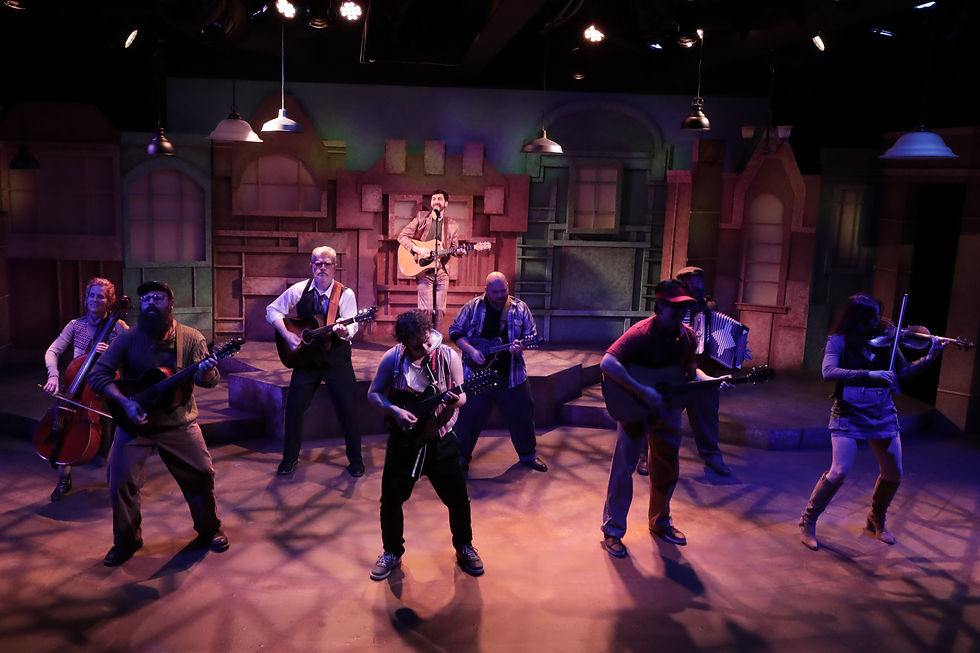
“Once” is also a story about community and how people from different cultures, languages and backgrounds who might never otherwise interact can find common ground through music.
Hansard and Irglová’s score leans into folk-inspired melodies and emotionally direct lyrics developed for their band The Swell Season. Songs like “Falling Slowly,” “Gold” and “If You Want Me” feel less like traditional showstoppers and more like confessions set to music. The effect is deeply human: raw, imperfect and achingly sincere.
In McHale’s vision, music becomes more than accompaniment; it becomes a bridge. “Music provides a way for these characters to see each other’s humanity,” he says.
While many productions of “Once” traditionally unfold almost entirely inside a pub, McHale says, “This will not be a typical production.”
Rather than anchoring the story to a single location, scenic designer Bradley Kaye presents a deconstructed homage to Dublin. It is inspired in part by Grafton Street, where the story begins. The scenic design evokes a city that is constantly in motion. Old and new architecture coexist. Locations shift fluidly, often blending into one another, reflecting how the characters drift through emotional and physical spaces alike.
“I think this design will allow us to imagine moving from place to place in this cool, cosmopolitan city,” McHale explains. “It’s filled with history, culture and diversity.”
Another significant departure from traditional stagings of “Once” involves how the ensemble is used. Many productions keep the ensemble onstage throughout. In this version, the ensemble drifts in and out of the action, sometimes appearing to support the music and sometimes receding as the focus narrows.
“People come into our lives and perhaps fade out,” McHale says. “But they very often have a profound effect on us.”
Projections further enhance this poetic sensibility. Used in a way McHale says he has not seen before in “Once,” they suggest locations, underscore emotional shifts and heighten the lyrical quality without overwhelming the intimacy.
It is also not a traditional musical where characters often sing their words. In “Once,” the songs convey emotional states rather than literal dialogue. They are poetic, open-ended and deeply personal. Given the music’s origins in indie folk, it feels accessible and modern, rooted in acoustic textures and raw emotion.
Crucially, the music exists organically within the world of the play. As musicians, Guy and Girl bond over songs. Later scenes unfold in rehearsal spaces and a recording studio. The music is not a theatrical convention but part of the characters' lived experience.

Casting “Once” is famously demanding, and McHale's process reflects the rigor required to bring this story to life.
The auditions began with performers singing while accompanying themselves on an instrument of choice. From there, actors submitted videos demonstrating proficiency on all relevant instruments. Callbacks asked performers to sing and play excerpts from the show, while also reading scenes using an accent.
The result, he says, “is an ensemble of extraordinarily multitalented artists.” Their versatility is an essential part of the storytelling. The visible act of making music together mirrors the emotional journey of the characters themselves.
With 10 actor-musicians playing more than 25 instruments throughout the show, sound design is one of the production’s greatest challenges. Sound designer James Markoski who previously worked with McHale on “Scrooge!,” brings extensive experience in live concert mixing, an invaluable asset in a show where clarity and balance are crucial. The goal is to preserve simplicity and intimacy while allowing the richness to shine.
Another frequent collaborator, lighting designer Jacqueline Malenke, who previously worked with McHale on “Sweeney Todd,” brings a bold yet sensitive approach to the production. Malenke’s designs support scenes that feel intimate and conversational while also allowing the music to lift the story into more expansive, poetic territory when needed.

For McHale, one of the greatest strengths of this production is its home. Being just feet away from performers playing guitars, violins, cellos, mandolins and more creates an immediacy rarely found in larger venues.
“With such an intimate and personal story, having it in an intimate space is a real boon,” he explains.
McHale comes to “Once” with a deeply personal history. He has performed in four productions of the show, appearing in more than 200 performances. Directing it now allows him to approach the piece from a new perspective.
Asked to name his favorite parts of the show, he laughs. “Everything.”
What resonates most, however, is how the music grows as the characters open up – instruments are added, harmonies deepen and the sound expands alongside their emotional vulnerability. The world of the play literally grows as the characters' hearts do.
In a time marked by disconnection, this production offers something quietly radical: a belief in listening, sharing creativity and the power of music to bring us together.
By the time the final chords are played, “Once” does not feel like a performance you watched so much as a story you lived alongside its characters.
‘ONCE’
Chance Theater
When: January 23 - March 1, 2026
Where: Bette Aitken theater arts Center, 5522 E. La Palma Avenue, Anaheim
Information: 888-455-4212, www.ChanceTheater.com
Anne Reid is a writer, public and community relations expert, and theater mom.


