
'Fences' Stands Tall as a Sad, Bitter Portrait of '50s Black America
- Eric Marchese

- May 7, 2025
- 5 min read
Updated: Aug 31, 2025
REVIEW: Laguna Playhouse softens the edges, but Wilson’s masterpiece is still as harsh as ever.

August Wilson’s Pittsburgh Cycle is among the most ambitious theater endeavors of the 20th century, and its plays among the most probing.
From 1985, “Fences” is arguably Wilson’s masterpiece, and among the most bitter portraits of ’50s Black America ever seen on stage. Its 1987 Broadway staging captured multiple Tony and Drama Desk nominations and awards, as did the 2010 revival.
In Laguna Playhouse’s new staging, director Yvette Freeman-Hartley works to soften some of the harsher edges – notably Corey Jones in his portrayal of Troy Maxson.
As a young man, Troy was a star of baseball’s Negro leagues, batting .432 and hitting more homers than anyone but Babe Ruth and Josh Gibson, even besting pitching great Satchell Paige.
In 1957, he’s now a garbage collector in Pittsburgh’s Hill district. Stoking Troy’s smoldering resentment is the slow progress of the Civil Rights Movement and the continuation of Jim Crow discrimination. As he puts it, “I just wasn’t the right color” to continue his career versus the gradual slowdown that comes with advancing age.
As we see in Laguna, Troy views life and speaks of it in terms of baseball – yet for all his yearnings for his athletic triumphs, in its essence, “Fences” is a ’50s-style kitchen sink drama.
All but one of the characters is a Maxson – wife Rose (Tamarra Graham); children Cory (K.J. Powell), Lyons (Sean Samuels) and Raynell (Amari McCoy); and brother Gabriel (Matt Orduña), with Troy’s pal and co-worker Jim Bono (Boise Holmes) as almost one of the family.
Wilson’s script and dialogue is tangily lifelike in the early scenes that generate authentic, modest laughs within us and in the tension of the later ones. Both cases soar due to our recognition of human nature.
The playwright puts the Maxson family’s dynamics under a microscope, including Troy’s flashes of temper, Gabriel’s wistful musings caused by a war injury to his brain and Lyons’s detached pursuit of a music career.
As we see in the hands of Freeman-Hartley and her cast, the generally jocular tone of the opening scenes gradually yields to bitterness, with the focus on the clash between Troy and Powell’s Cory, the teen son who dreams of a career in sports.
Troy has been portrayed on Broadway by James Earl Jones and Denzel Washington, and it’s a monumental role whose relationship with son Cory is at the show’s heart.
Troy insists Cory stick to his grocery store job, then complete his education and work in a trade, shunning athletics. As Cory defies him, their clashes grow ever more rancorous, including one especially vicious physical clash with a baseball bat.
As the ill will ratchets up between father and son, Wilson has us asking whether Cory can ever forgive Troy for all the venom.
In an Act One highlight, Troy insists he doesn’t have to “like” his son – only take care of him and prepare him for the world. This isn’t just tough love – it’s the most draconian discipline.





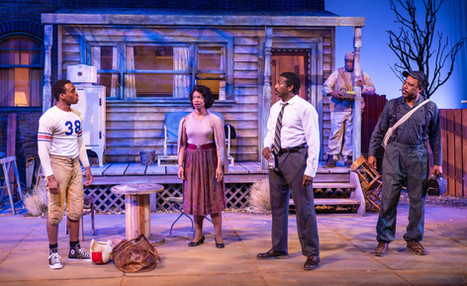
PHOTO 1: In Act Two, the marriage of Troy (Corey Jones) and Rose (Tamarra Graham) grows increasingly stormy. PHOTO 2: Corey Jones delivers the role at the heart of Wilson’s play – bitter ex-baseball player Troy Maxson. PHOTO 3: Playwright Wilson uses “Fences” to focus on the increasingly bitter conflict between 17-year-old Cory Maxson (K.J. Powell, left) and father Troy Maxson (Corey Jones). PHOTO 4: A lighter moment among Bono, Troy, Lyons and Rose. From left: Boise Holmes, Corey Jones, Sean Samuels and Tamarra Graham. PHOTO 5: Laguna’s cast stars, from left: K.J. Powell, Tamarra Graham, Corey Jones, Matt Orduña and Boise Holmes. Photos courtesy of courtesy of Laguna Playhouse/Jason Niedle/TETHOS
Laguna’s polished and slickly professional production is flawless, its staging pulling Wilson’s vision of ’50s Black America off the page, charging it with realism. Freeman-Hartley’s direction expertly carries the rhythms of Wilson’s script, capturing the realities of Black urban life of nearly 70 years ago.
In Laguna, Jones, Graham and Powell are the focal points, with sterling support from Holmes, Orduña, Samuels and McCoy.
Throughout “Fences,” Troy asserts that he “came along too early.” He’s caught up in the grip of circumstances – some of his own making, some not. The complex character is easier to take in the hands of Jones, who makes the role more sympathetic than is typically seen.
At times in Laguna we feel for Troy as he tries to hold the family together – even late in Act Two when he drops a bombshell on Rose and we ask ourselves how much Rose can and will take from Troy.
Graham delivers the no-nonsense personality of a wife who takes no guff from her spouse. As for Cory ever playing baseball or football professionally, Troy insists “the white men are not gonna let him play,” and no audience can help but feel for Powell’s Cory, a 17-year-old whose entire life is ahead of him but whose father refuses to help him invest in his dreams.
Edward E. Haynes Jr.’s set design evokes the shabby blue-collar trappings of the Maxson family through the house’s back façade and backyard, with Lanny Hartley’s pungent, lightly jazzy original music score enhancing the text.
The work of the design and production teams – Dana Rebecca Woods (costumes), Donny Jackson (lighting), Jesse Worley (sound), Kevin Williams (properties), Danielle Richter (hair and wigs), Marc Antonio Pritchett (fight coordination) and Natalie Figaredo (production stage manager) – is all of a piece.
Wilson’s title refers to barriers both literal – the structures surrounding Troy’s house he repeatedly attempts to repair – and figurative – the racial obstacles Troy sees as factors in American life and society having prevented him from realizing his dreams.
As real are the fences Troy has built around himself, prompting us to ask whether anyone can break through.
Despite the harsh emotions permeating “Fences,” late in the play Wilson offers glimmers of light: Troy becomes Pittsburgh’s first Black garbage truck driver, we see Cory in a Marine corporal dress uniform, and Raynell is a breath of innocence and joy for the Maxson family.
The great playwright softens some of the play’s harsh tones, and Laguna’s director and cast pick that ball up and carry it forward.
‘Fences’
When: Through May 18. 7:30 p.m. Wednesdays through Saturdays; 2 p.m. Thursdays and Saturdays; 1 and 5:30 p.m. Sundays. Running time: 2 hours, 30 minutes (including intermission)
Where: Laguna Playhouse, 606 Laguna Canyon Drive, Laguna Beach
Admission: $51-$105
Contact: 949-497-4727, lagunaplayhouse.org



.png)


