
A Candid Talk with Kathryn Kanjo, the New CEO at UC Irvine Langson O.C. Museum of Art
- Richard Chang

- Feb 13
- 7 min read
Kanjo, who has spent three decades as a museum director and curator, is steering the Orange County institution through many changes and changing times.
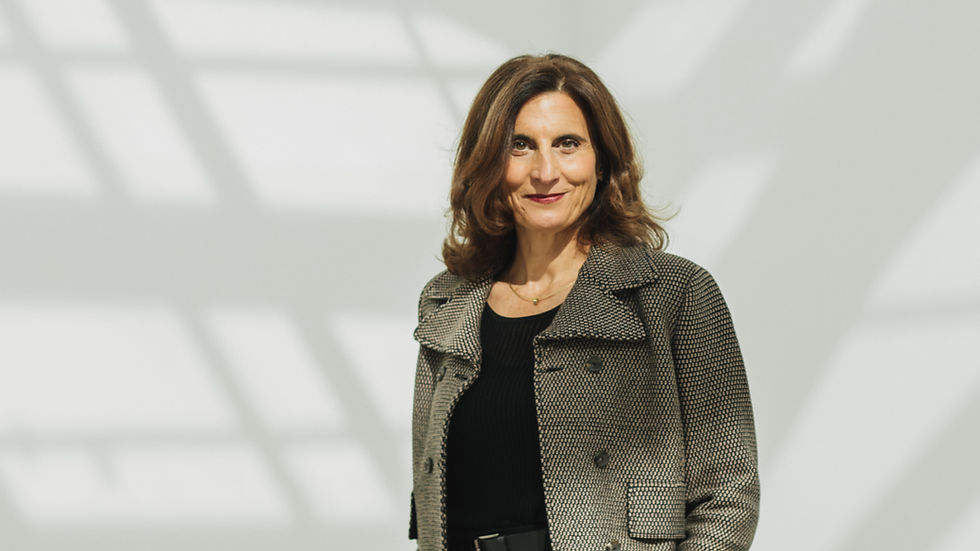
Kathryn Kanjo is the new CEO and director of the UC Irvine Langson Orange County Museum of Art. The longtime museum administrator, curator and Southern California resident takes the helm during a time of major transition for the museum, which was officially taken over by UC Irvine in September 2025, then merged with the UCI Langson Institute and Museum of California Art (IMCA) in Irvine.
OCMA had enjoyed 63 years of being an independent nonprofit art institution prior to the takeover/merger. But signs of disarray emerged over the last couple of years, with the departure of several prominent board members and the resignation after five years of former CEO and director Heidi Zuckerman in December. At UCI Langson IMCA, inaugural director Kim Kanatani resigned somewhat unexpectedly in March 2024 after five years there. Rich Aste served as interim director from May 2024 to February 2026.
Kanjo, 61, previously served as CEO and director of the Museum of Contemporary Art, San Diego for nine years. She had been on staff there for the past 15 years, including serving as chief curator. Prior to that, she served as director of the University Art Museum at UC Santa Barbara and Artspace San Antonio, and held curatorial roles at the Portland Art Museum and the Whitney Museum of American Art.
At UCI Langson OCMA, Kanjo will oversee a collection of more than 9,000 works, and a budget of at least $10 million for fiscal year 2026-27. She has already made a new home with her husband in Corona del Mar. (She has a son who lives in San Diego and a daughter who lives in Sacramento.) Her first day on the job was Feb. 2. Kanjo took some time recently to chat with Culture OC about her new position and what she’s looking forward to at the newly branded, merged museum.

Culture OC: Welcome to Orange County and the O.C. arts and culture community. It’s a little unusual for a major university to take over an independent museum with a long history, although not unprecedented. How do you balance the independent voice of the museum versus the needs and interests of a state-run university?
Kathryn Kanjo: I think it is an unusual model. I think it’s an exciting model, and I think it’s the right model. I don’t see the university’s role in some way limiting the community that we’re aiming to reach. This is a campus turning out toward the community. It’s expansive for UCI.
I think of the UCI support, the university support. However we say it, UC Irvine or UCOP (University of California Office of the President). We’re grounded in research; we are at the service of our community. I don’t see it as limiting my independence, or the curatorial independence of the institution. If anything, it gives us greater freedom from the pressures of market influences.
Many museums are looking for a sustainable financial model, and the philanthropic model can be prone to market influences. We say it’s independent, but you’re always working to maintain your integrity. There’s usually many stakeholders behind any nonprofit, with various interests that may or may not be consistent with the nonprofit’s goals.
It’s a position you have to be mindful of, no matter where the support is coming. I’m thrilled to be anchored by ideas, by a top-tier research university. I see UC Irvine as being reflective of an inclusive community. That’s exciting for me.
COC: The exhibition schedule had been planned by Heidi and her team for a while now. How long will that programming continue, and when do you start your fresh slate of new exhibitions and programming?
KK: To be candid, it’s a little early for us to say, the timing of what projects are coming. Projects are nascent and are brewing. It’s a little early to say if some of those are going to continue or not. For sure, we’ve got a year of programming coming forward that’s already been in existence, not just through the team at OCMA, but also the team at (UCI) Langson (IMCA).
In June, we’re going to take an exhibition that had been planned for the Von Karman location, and that will be shown alongside a special exhibition at the Costa Mesa facility.
COC: As far as staff is concerned, how many people are you retaining, and how many people are you switching out?
KK: We have great talent coming from both institutions. Right now, we’re assessing the needs of the future organization to see what roles continue or how job descriptions might change. So it’s really a little early for me to say that.
It’s not just about the right size, but about the right expertise and the right skills for the fuller museum. We have a larger collection and a larger time period.
COC: OCMA focused on modern and contemporary art, whereas the old Irvine Museum (UCI Langson IMCA) featured work from the mid-19th century to the mid-20th century. Is there still a dedication to contemporary art, younger, emerging artists and living artists?
KK: Absolutely; it’s part of the DNA of – particularly looking from the collection point of view, from (collector Gerald) Buck. Buck was looking at history, what’s happening in California in his time period. He collected quite intensely – artists from the ‘80s, in the ‘80s. That contemporary impulse was with Buck, it certainly is with Orange County (Museum of Art) from its founding (on) the (Balboa) Peninsula.
The speculative approach in what’s next is certainly – that’s my wheelhouse, but also the interest of the university – being forward looking.
COC: So the old OCMA board has been disbanded and is there a new board?
KK: With the acquisition (by UCI), the governing structure had to change. As a 501(c)(3), OCMA had a fiduciary board that has been dissolved. The governance comes from UCOP – the (UC) Office of the President. There had been an advisory committee that includes stakeholders from the prior group.
COC: Can you tell us more about the circumstances that led to UCI taking over OCMA? It still seems like a mystery to some of us, and it seemed to happen overnight.
KK: I don’t know that I can … I was not engaged at the institution during that process.
I know the (museum) has been in conversations with UCI for many months. UCI had been interested in expanding its presence further out into the community. I don’t know. It didn’t seem fast to me. Obviously it’s a mutual decision when you have the two entities working together.
COC: UC Irvine had raised a fair amount of money, and had budgeted $100 million for the new building. Where’s that money going to?
KK: Rather than going to a construction, it’s working with the merger, and the cost of operating that facility. I would imagine that’s where the fundraising has been directed thus far, for that process of the merger and for future operations.
COC: Is some of that money going toward future acquisitions?
KK: I don’t think acquisitions? I think operations. I have not heard that, so I don’t know. I’d have to check.
COC: You’ve been a museum director and curator for over three decades. What are some highlights from your career?
KK: For the last 15 years, I’ve been at the MCASD, nine years as CEO. A highlight of that was completing the expansion that doubled the footprint to 110,000 square feet, resulting in 40,000 square feet of exhibition space. The budget was $105 million, which includes an endowment. The building itself cost $95 million. It’s a glorious building; we love the building. It was done by Selldorf Architects, with Annabelle Selldorf as the design architect.
My highlights were also my curatorial contributions. I organized an exhibition of Jack Whitten – five decades of painting, paying attention in a retrospective way to an artist who really found his voice in the ’70s. That was our sweet spot – that was a great highlight.
As chief curator and CEO, you’re leading a team. I’m proud of the curatorial track record of the museum for doing innovative shows, including group exhibitions that pushed the field forward.
My reputation as a museum person includes being sensitive to artists. I studied art history (at the University of Redlands). I’ve been working with living artists and commissioning artists to realize projects that they couldn’t otherwise have done.
COC: Where were you born? Where did you grow up?
KK: I’m a Californian. My dad was a first-generation Californian, so I’m very happy to be here. I’m from Redlands. I was born in Redlands. I got my undergraduate degree at the University of Redlands, and my graduate degree at USC.
Museum work takes you – you go off to where the opportunity is. I’ve been fortunate that I’ve gone to cool places: New York, San Diego, Oregon, San Antonio. But I’m delighted that I was able to have these last three positions all be in California.
COC: How big is the staff at OCMA? Are you retaining Courtenay Finn as your chief curator?
KK: The Staff is about 85 bodies, headcount (that sounds so medical), with 40 full-time people. Courtenay’s on staff, absolutely. We have four curatorial folks with us.
COC: What’s your vision for the future of UCI Langson OCMA?
KK: I’m excited to assess all that we have here, and see how we move forward. The excitement in working from this collection – we can draw from the history of our holdings.
We also have the intellectual rigor of the university to look at where we’ve been, and see where we’re going forward. We’re aiming to do exhibitions that are deeply researched. I’m excited about codifying them with publications, so there’s a legacy of what’s created by the curatorial team.
Artists are seers – they get there before we do. We’re seeing how we can both reflect our world as it is, and imagine what it’s going to be.
I’ve got to do a bit more listening with the team and the community, to see what makes sense. I’m thrilled. I’m delighted to be here.


