
The Contentious History of Orange County’s Chicano Murals Turns a New Leaf
- Abigail Stephens

- Jan 19
- 6 min read
Updated: Feb 13
The restoration of famed muralist Emigdio Vasquez’s ‘Chicano Gothic’ marks a historic moment of community and government collaboration to preserve Latino public art.

You can catch a glimpse of the orange fields through the chain link fence at Santa Ana’s Memorial Park. Past the mud churned from the construction site floor, these fields are preserved on one mural among torn down concrete, a window through time to Orange County’s orchards and first Chicano workers. It is not a miracle that this portal to the past exists. It needed all the hands of modern Santa Ana to keep it standing.

This is “Chicano Gothic,” a mural painted in 1987 by Emigdio Vasquez, one of the founding fathers of the Chicano Art Movement. For almost 30 years, “Chicano Gothic” stood at Santa Ana’s Memorial Park pool, depicting Latino migrant workers and the land where they sowed community seeds. Now it stands alone, waiting for the $29 million renovation to upgrade Memorial Park’s aquatic center, opening in 2026.
Back in May, there weren’t many who predicted “Chicano Gothic” would stand as it does today. Plans to tear down and re-create the mural elsewhere were narrowly avoided through local organizations and community members guiding city staff in imagining possibilities of preservation.
At the forefront of these efforts is the Santa Ana Community Artist(a) Coalition. Founded by artists Alicia Rojas and Roger Reyes in 2013, the coalition creates new murals through community input and advocates for existing art. The team restored famed artist Sergio O'Cadiz’s wall at Fremont Elementary in 2023 and “La Raza” on Civic Center Drive in 2024.
“We've been told ‘no’ a lot. And I think as an artist, I have learned to use creative ways and visual ways and advocacy ways to say, ‘si se puede.Yes we can.’ We can save this wall,” Rojas said. “In the city, they're limited to rules. So we, as artists, are coming in as problem solvers, as creative thinkers. When an artist is invited to the table of planning and design, magical things happen.”
Nipped in the Bud
The impending re-creation of “Chicano Gothic” was particularly unnerving to coalition founder and artist Reyes. After watching Vasquez paint Santa Ana Boulevard’s “Visions of Orange County” mural in 1991, a young Reyes searched for Vasquez’s other works across the county.
“Visiting the pool was one of the ways that I was exposed to art. We didn’t have the type of access that others might have to galleries. I saw my art in parks.” Reyes said. “When the fences went up saying there would be a renovation of the pool area, they had a QR code that said, ‘Ask us your questions.’ Immediately I was like, ‘What are you gonna do about the mural?’ Never got an answer.”
This lack of initial communication fanned fears that “Chicano Gothic” might end up facing the same bleak fate as the county’s other Chicano creations.
In the 1970s, controversial murals by Latino artists started sprouting throughout Orange County. Famed artist Sergio O'Cadiz Moctezuma’s “Colonia Juarez” mural was opposed by police in the late 1970s for including a young Latino being dragged into a cop car. After the mural was vandalized, the city of Fountain Valley withdrew funding from O’Cadiz. The wall was bulldozed in 2001, due to “seismic dangers.”
In Fullerton, the Lemon Street Murals were painted in 1978 by artists such as Vasquez, who wished to prevent graffiti and inspire community pride. In 2008, Councilmember Shawn Nelson, now a county judge, called the murals “crap” and stereotyped lowriders as gang iconography, before publicly apologizing for his comments. These murals were eventually restored with funds raised by Councilmember Ahmed Zahra in 2023.
While support for Chicano representation has grown exponentially among local communities and government officials, conversations on saving public art are complicated by misunderstandings around mural restoration. In May, the month of Santa Ana’s Emigdio Vasquez Day, city staff announced that they planned to demolish “Chicano Gothic” and support Vasquez’s family in re-creating it at a different location.
According to Tim Pagano, deputy director of Parks and Recreation, this was not an immediate decision. In 2021, the Parks and Recreation Department talked to Emigdio’s son Higgy Vasquez and explored options for restoration versus removal.
“At some point, there was a cross section of us going to a neighborhood association at Washington Middle School and that's when Alicia introduced herself in a very assertive way and said, ‘Hey, there's probably another way to do this,’” Pagano said.
To determine every possible route to preservation, Rojas called in expert MuralColors, an L.A.-based art preservation company. MuralColors brought solutions to the city that they didn’t know were possible, such as stripping the image from the wall and adhering it to metal. Excited by emerging possibilities, the council began advocating for the wall's full restoration, allowing it to stand freely outside the renovated aquatic center.
“Councilwoman Jessie Lopez, Mayor Pro Tem Benjamin Vazquez and Councilman Johnathan Hernandez have been the biggest art advocates that we've had in the city for a long time,” Rojas said. “They said, ‘Educate us. I love what you're saying, you're so passionate. We were not aware.’ I think everybody unites in art on the city council.”
PHOTO 1: From left, Carlos Rogel and Dr Davida Persaud of MuralColors, with Alicia Rojas and Roger Reyes. PHOTO 2 - 4: The Santa Ana Community Artist(a) Coalition and MuralColors at work restoring “Chicano Gothic.” Photos courtesy Santa Ana Community Artist(a) Coalition/Alicia Rojas
History, Secured at its Roots
When a young Emigdio Vasquez moved from Jerome, Arizona to Orange, he watched his father and brothers work daily in the orange fields. As an adult, Vasquez was a prolific artist, depicting the lives of working class Chicanos in Orange County. In 1987, while a Bowers Museum resident artist, Vasquez won a state grant to paint murals on city properties, such as “Chicano Gothic” in Memorial Park.
Dedicated to upholding her family legacy, Rosemary Vasquez Tuthill, Vasquez’s daughter, aided the restoration by uncovering family images to help preservationists reproduce erased sections of the mural.
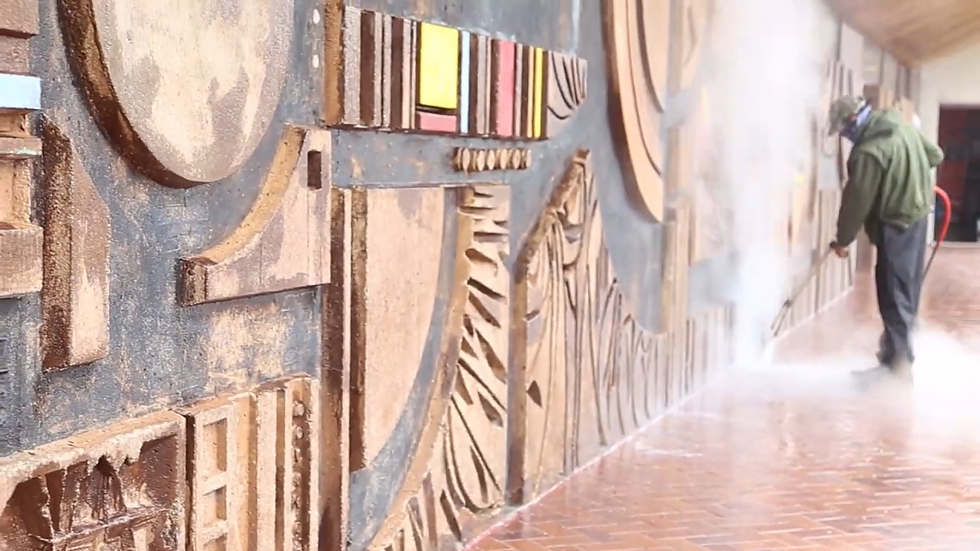
A major concern at the beginning stages of preservation was that the mural’s paint was in the process of degrading. According to Carlos Rogel of MuralColors, the original paint layer was detached from the wall. After washing away decades of grime, pollution and oils, MuralColors reattached the pigment, returning the mural to its original vibrancy.
The coalition and MuralColors also worked with a structural team to address fissures found within the wall. Steel reinforcements were installed on the back of the wall and within its new foundation, allowing the mural to remain free-standing for years to come.
“(Emigdio Vasquez) would stand here in disbelief over how well it's being cared for and saved,” Vasquez Tuthill said. “When the kids are swimming here, hopefully they'll think how fortunate we are. We're the only pool on the planet that has this beautiful mural.”

Sowing the Seeds of Tomorrow
Beyond restorations, Vasquez Tuthill is aiding Rojas in creating a digital archive, including oral histories, early photographs and information on why it's important to preserve Vasquez’s work.
Education is an essential part of the coalition’s practice. After repairing O'Cadiz’s Fremont Elementary wall, the students received coloring books about O’Cadiz. For “Chicano Gothic,” Rojas plans to host similar workshops for Washington Elementary School, which neighbors Memorial Park.
Beyond the Aquatic Center’s opening in 2026, the coalition plans to celebrate “Chicano Gothic” again in 2037, celebrating the mural’s 50th birthday. At 50 years, the coalition can apply to designate the mural a historical landmark, protecting it from future demolitions. Rojas believes that this provides the county a unique opportunity to celebrate local heroes.
“I believe through public art, we are telling history and sometimes we're rewriting history. Whose voices are we celebrating and whose voices are we not?” Rojas said. “I think it's important for us, the city of Santa Ana, to preserve our cultural landmarks, histories and stories of what makes Santa Ana Santa Ana – our immigrant families, families like Rogers and families like mine.”
Next to “Chicano Gothic,” Santa Ana is building a 1,000-square-foot community room, accompanied by a seating area for mural viewing. The room will border both a competition and recreational pool, water slides, a lazy river and splash zone. Ticket prices are currently set at $3 for adults, $2 for seniors and $1 for kids, with a monthly free day for residents.
Pagano believes that public art fits perfectly in Santa Ana, a city founded on family ties and cultural pride. Both city staff and the Santa Ana Community Artist(a) Coalition have found that local parties involved in the restoration process became invested in “Chicano Gothic” after learning its history. In particular, Rojas was delighted by the support of the contracted construction crew.
“Everyone is learning and geeking out with us. We were showing (the construction crew) Emigdio’s original pictures. They're like, ‘Oh my God. We get it now,’” Rojas said. “I think our city has the potential of treating these public pieces as an open museum, having educational components and tours where people can see this work. It's so exciting. The sky’s the limit.”


