
Meet Eli Simon, the Visionary Behind the New Swan Shakespeare Festival
- Ashley Ryan

- Jul 3
- 8 min read
From behind the scenes to center stage, Simon's dedication to the New Swan Shakespeare Festival earns him a Cultural Legacy Award.

Nearly four decades ago, Eli Simon began working at UC Irvine, and no one could have predicted the immense impact he’d have during his tenure.
Now a chancellor’s professor of drama at the Claire Trevor School of the Arts, he previously served as chair and head of acting for the department, helping educate and inspire thousands of students in Orange County over the years. Simon is also the creator and artistic director of the New Swan Shakespeare Festival, preparing to launch its 13th iteration this July in association with UCI’s research-focused New Swan Shakespeare Center (which he also founded).
In September, Simon will have another new addition to add to his resume as he accepts the Helena Modjeska Cultural Legacy Award at the annual Orange County Arts Awards. With this honor, he reinforces his role – and New Swan’s – as pillars of the local arts scene.
A Career in the Making
In his youth, Simon bounced back and forth between the West and East Coasts. Born in San Francisco, his family relocated to Brooklyn, New York, then returned to California and settled in Berkeley – all regions known for their artistic flair.
Before he discovered theater, his first love was music. “I've always been fascinated by the performer-audience relationship,” Simon said. “I first explored that in music. I started out as a percussionist, playing in orchestras, jazz combos and rock bands.”
He began thinking about the theatricality of music as a teenager, but it wasn’t until his undergraduate drama studies at UC Davis in Northern California that he began blending his musical interests with theater and fell in love with the craft, saying he “never wanted to leave it.” After completing his bachelor’s degree in drama, he moved again to the East Coast, earning his MFA in acting from Brandeis University, a liberal arts college just outside Boston.
Already a devoted concertgoer, he began weaving theatrical performances into the mix as well. “Every show that I took in was a revelation,” he said. “The rock concerts that I saw early on affected me deeply. I remember seeing the Rolling Stones in the ’70s, Bruce Springsteen in the early ’80s along with Earth, Wind & Fire, Bob Dylan, James Brown, Tower of Power and The Police. These performances, in terms of the musicality and visual presentations, had a lasting impact on me.”
Despite his instant connection with the world of theater, he soon realized that his true passion lay behind the scenes. “The most important thing I learned in my actor training program was that I have the mind of a director, not an actor,” Simon said. “I’m a multitasker by nature. Actors need to stay focused on one thing at a time: what they are hearing, then what they are saying. When I was acting, I was thinking about things I certainly shouldn’t have been thinking about, like lighting and sound cues or how I would have staged the scenes I was in. So when I started to direct, I instantly felt like a fish in water. My artistic satisfaction has always been centered around conceiving and staging plays.”
In the Round
In the 1980s, Simon was freelancing in theater, looking for any directing work he could find, before landing a teaching job at his alma mater, UC Davis. But his whole life would change when he moved to Southern California in 1988 to work as a professor at UCI.
It was more than 20 years before Simon would fully develop the idea for the New Swan Shakespeare Festival. In 2010, he sought input from other theater-makers and all were in agreement that the performances should be intimate, open-air displays where every seat feels close to the actors.
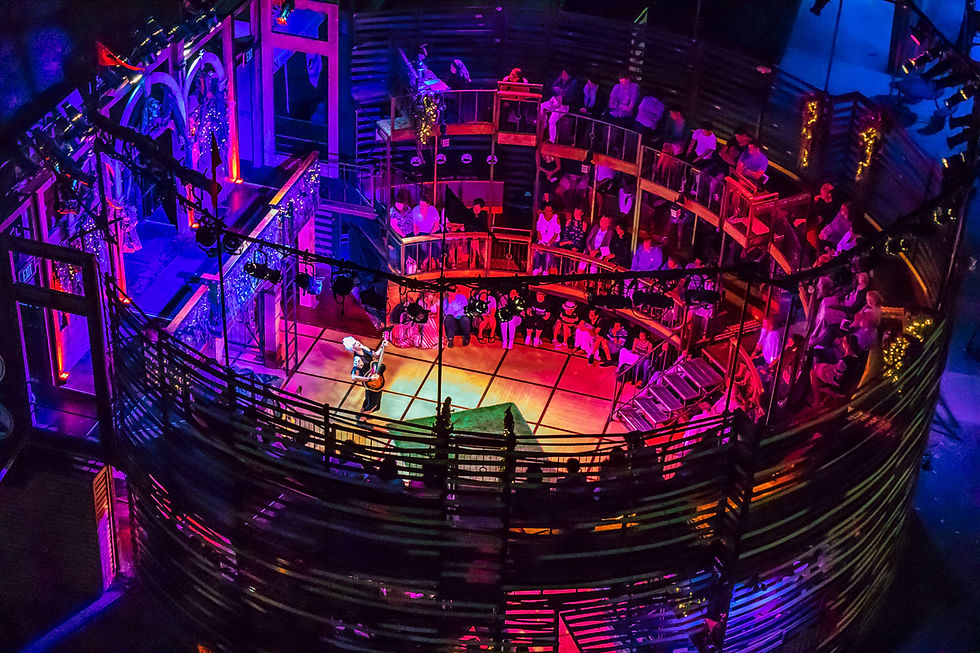
After securing the funds for the physical theater, Simon enlisted the help of scenic designer Luke Hegel-Cantarella to build a miniature replica of Shakespeare’s historic Globe Theatre. The portable replica, which seats 137 people in a 15-ton cylinder, was built in 2011 and then all that was left was to find a spot for it. “I got on my bike, rode around and found this beautiful plaza on the gateway to the campus, right next to Aldridge Park, and I thought, ‘This is the spot,’ ” Simon said. “I shared my dream of a festival with Chancellor Michael Drake and he said, ‘I wish it was tonight.’ ”
Taken down at the end of the festival and rebuilt again the following summer, the construction process is rather intense due to its size and weight, with flatbed trucks and professionals on hand to haul the pieces into place. But the result is an enchantingly rustic outdoor theater that allows Simon, the actors and the crew to put on truly magical performances in the round.
“The initial idea was to create a magical space for both the actors and the audience to experience these plays together. Then we set about telling these stories as clearly and evocatively as possible – and that's been the formula,” Simon said. “These brilliantly written stories belong to us all. Once you start delving into Shakespeare’s canon, the plays pull at your heartstrings. They are alive and they want to be staged.”
As the artistic director, Simon is tasked with selecting the two plays to be performed each summer, with the festival following a rotating repertory in July and August. This year, New Swan kicks off July 7 with “Romeo & Juliet,” a beloved classic that has only been presented once during the festival, back in 2014. Rachael VanWormer, a prominent actress with New Swan over the last two seasons, will make her O.C. directorial debut with this Dust Bowl-era production. “Her take is brilliant,” Simon said. “She’s able to bring ‘Romeo & Juliet’ to life in the Swan, and this particular play features incredibly rich language. The actors are, once again, rising to the occasion.”
The second production, directed by Simon, is “The Merry Wives of Windsor Cove,” a unique musical adaptation set in a California beach town in the 1950s. While many songs draw lines directly from the Bard’s play, others have lyrics that are entirely original. “The music that Zach(ary) Dietz has written is catchy and exciting,” he said. “We have a first-rate skiffle band and wonderful singers. It’ll be a first for everyone that sees this musical …. I can’t remember being so excited about a show.”
Much of the excitement of these performances – both for those in the plays and for attendees – is the intimacy of the theater, where the audience is within 10 feet of the action at all times. “There’s no barrier between the actors and the audience,” Simon said. “We invite the audience inside the play with us. This audience-actor relationship changes the way the performers normally experience a play …. Being surrounded by the audience calls for the actors to be truthful and present at all times. You can’t fake it in our theater.”

Clowning Around
While much of his life has been dedicated to Shakespeare, Simon has a second focus as well that also deals in the realm of comedy: clowning. And this third pillar of his career (after teaching and New Swan) is as wildly successful as the festival itself.
In addition to three books written on the subject, Simon has been able to showcase this alternate side of his artistry around the world through productions with the silent troupe Clownzilla and the masked California Commedia Troupe.
“I’m especially proud of my touring clown shows,” Simon said, “because we were able to bring our form of silent clowning to Italy, Korea and England. We were embraced wherever we toured. That was a singular experience, and it deepened my conviction that theater has the power to unite people from disparate countries, cultures and beliefs.”
One of his most notable shows, “War of the Clowns,” was held at the Lucian Blaga National Theatre in Romania, filling an opera house to discuss the issues of war through the lens of a clown-centric theater piece.
Though the subject matter is different from the works he produces for New Swan, he uses the same acting techniques to help actors build confidence and find a means of expression in a collaborative way. “I’ve been teaching clowning for over 30 years and I’ve never met the same clown twice,” he said. “My form of clowning is centered on finding and exploring your own unique clown persona; it’s not about becoming a particular kind of clown. I’m always learning, always discovering, and it’s fascinating to watch actors unleash parts of themselves they didn’t know existed.”
While clowning may have traits unique to the genre, Simon has identified several ways in which they connect to the acting techniques he teaches at UCI. “We can, as teachers, create opportunities for people to grow and learn, and I feel like that’s what I’ve attempted to do in class,” he said. “That’s what Swan is about as well: It’s a place where you can practice your craft, improve and ultimately share your skills. That’s the art of being a theatrical artist. You learn, you grow, you share. It’s a beautiful arc.”
Celebrating Simon’s Cultural Legacy
When Arts Orange County hosts the 26th annual OC Arts Awards on Sept. 29, Simon will be honored with the Helena Modjeska Cultural Legacy Award for Visionary Arts Leader. Having directed more than 100 plays between regional and international theaters plus Shakespeare festivals, he stands as one of the region’s most enduring champions of live theater.
“I was very surprised. I feel humbled and honored by it,” he said of the recognition. “With the help of many others and the backing of the university, I was able to create New Swan Shakespeare Festival and … I’ve thrown my life into it. Keeping the festival afloat has taken energy and commitment. I would say that visionary leadership is as much about sticking with it as it is about great ideas.
“My formula has been to keep everyone on the team as fulfilled as possible, to partner with true collaborators and to give everyone at the table a voice that can be heard. Theater is essentially collaborative, so I’m constantly reminding myself that my good idea isn’t the only good idea. I’ve done my best to give everyone in the New Swan company room to grow, be expressive and feel like they’re a part of a formula that creates meaningful art.”
With 38 years (and counting) of instruction under his belt, and 14 since New Swan began, Simon reflects on his journey, crediting UCI for giving him the freedom to research, experiment and follow the creative impulses that shaped his career. And despite everything he’s already accomplished, Simon feels it’s more essential than ever that we support the arts.
“I ride my bike to school and see most of our students walking with their heads down, eyes glued to their phones,” he said. “And I think, ‘Do these students want to see live theater?’ If they don’t, they should, because it might lift their spirits …. The living arts are essential for our well-being. Phones and social media will suck the life out of us. I say, put your phone down for a couple of hours and drop into a New Swan production. I’m guessing this experience will help you feel better about yourself and the world you live in.”
Overall, Simon hopes the legacy he’s leaving with New Swan inspires future students to embrace the works of the Bard. “Keep reading Shakespeare, watch it produced on stage and get involved in helping artistic communities around you,” he said. “Being able to read a great play is a privilege and a pleasure, and staging it or watching it in performance can be a peak experience in your life. At New Swan, our students and community members come to realize the potential of these plays. Hopefully, the next generation of theater-makers will continue to perform, design and direct these awe-inspiring works. As Hamlet says, ‘We know what we are, but know not what we may be.’ ”
New Swan Shakespeare Festival
When: “Romeo & Juliet”: 8 p.m. July 7-Aug. 29; “The Merry Wives of Windsor Cove”: 8 p.m. July 8-Aug. 30 (see website for specific dates)
Where: UC Irvine, Gateway Commons, 4242 Campus Drive, Irvine
Cost: $28-$115
Information: newswanshakespeare.com


