
For Anaheim Ventriloquist Christine Barger-Lutes, Every Puppet Has a Voice
- Jessica Peralta

- Apr 27
- 8 min read
Her troupe of puppets – from a sassy wooden figure to a sensitive skunk – reflects a lifetime of craft shaped by imagination, loss and performance.
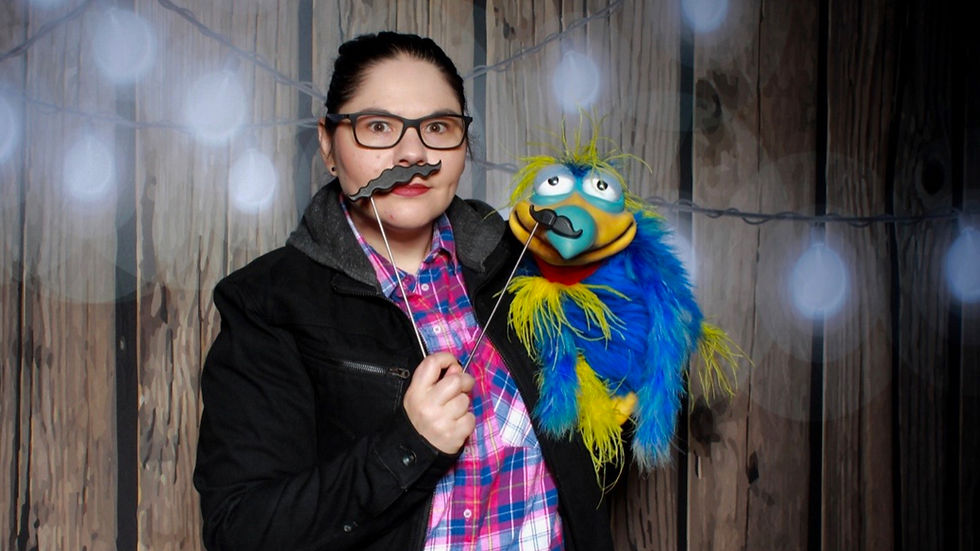
Darlene Hollywood has strong opinions and is a bit of a flirt. Stunkles the skunk gets very offended if you say he stinks. Darwin D. Dodo means well – even when he says something that isn’t totally appropriate.
“Billy Yonkers is a young, adult male, soft puppet that is my improv partner and we do something called Ventrilo-Prov together,” said Christine Barger-Lutes of Anaheim. “He is witty and quick and will sometimes be a bit blunt or rude.”
Barger-Lutes has a team of puppets she’s developed over the years as a ventriloquist, each with their own defined personality, character and look. But the 46-year-old actress, social media content creator and escape room owner didn’t start playing with puppets with performance in mind. It rose out of necessity.
“I started doing ventriloquism when I was very young as a way to cope with my baby brother’s illness and then his death,” she said.
Her brother, Bobby, was born prematurely and his lungs didn’t develop fully, leading to health issues. He passed away at age 3.
“He was in the hospital and we stayed at the Ronald McDonald House and there was another child staying there,” she said. “(The child) had a stuffed Gizmo doll and … said that he didn’t want to talk to me because he didn’t like me, so I made my teddy bear talk to everybody except that child because I wanted to show them how bad it felt when a stuffed animal didn’t like you – plus I didn’t believe that Gizmo really talked to (the child).”
Shortly after her brother passed away, her family moved and she started a new school in third grade.
“It was really hard to come into a new school at that age and make friends,” she said. “I was teased a lot and having my imaginary friends to talk to helped and then I started to kind of get known for that talent, which both helped and hurt my popularity.”
Though some children would make fun of her for talking to herself, most people found it interesting. She won talent shows and in high school, she won a state-wide talent competition in Indiana, getting her on television for the first time performing ventriloquism.
Ventriloquism, which developed as a form of entertainment by the 18th century, has two days of recognition because they celebrate puppetry. World Puppetry Day is on March 21 and National Day of Puppetry is on the fourth Saturday in April, this year on April 25.
Barger-Lutes was doing it before she even knew what it was.
“As a kid, I just thought it was an easy thing to do and I did it,” she said. “I never really learned from books or took classes or anything. I didn’t even know what a ventriloquist was. I just knew I could make my toys talk and then I got a puppet and started making puppets talk. I was older when I saw a ventriloquist for the first time.”

Puppet Talk
Barger-Lutes got Darlene Hollywood in the mid-‘90s in Littleton, Colorado from a ventriloquists’ store. Darlene is made of wood.
“She looks a little bit like me, but she’s much sassier and her hair is in pigtails because if you take it out, it’s a mullet,” Barger-Lutes said. “Basically she is the most typical ventriloquist character that I have. She will often razz me and give me a hard time, poking fun at me as the ventriloquist.”
Stunkles the skunk is an Axtell puppet with big, blue eyes. Since he’s been “de-scented," he does not stink and gets offended if told otherwise. (Axtell Expressions was founded by Steve Axtell in California in 1982.)
“He is the puppet that I have used for years at kids’ shows to discuss topics like judging a book by its cover and bullying,” she said.
Darwin D. Dodo is a sleepy dodo bird who’s a little slow in his rate of speech and also in noticing things. He’s also an Axtell puppet. She said she and Billy Yonkers did a Fringe Festival show together years ago doing Ventrilo-Prov.
“It’s basically short-form improv with a two-person team and I am the two-person team,” she said.
She has 20 or more other puppets, but she doesn’t use them as often.
She usually gets a puppet because she’s drawn to it and then creates the personality, voice and name after playing with it for a time.
“I have a few puppets that I’ve had for years and I’ve tried multiple times to come up with voices and personalities and names and still haven’t,” she said. “I rarely come up with a character first and then try to place a puppet with the character – although I did that once and it didn’t go well.”
She said she had an entire character based around a personality she’d created and ordered a custom-made puppet. But when she got it, things didn’t feel right with the personality or voice she had developed.
“So that puppet is sitting in a suitcase and occasionally comes out for lip sync on TikTok, but it has no voice, no name and no personality and it’s a beautiful puppet and I love the puppet,” she said. “I just don’t know what to do with it.”
Having puppets isn’t all about playing with them, there’s some care involved. Barger-Lutes said puppet pricing can range from the cost of materials to build them yourself to thousands of dollars — depending on what type of puppet you’re getting, who’s making it and what features you want to have.
“A wooden figure could be hand-carved and have features like winking and blinking eyes, mechanisms that make her cry or spit,” she said. “All of those additional things cost more.”
She keeps Darlene Hollywood lying on her back in a case so pressure isn’t on the puppet’s face or jaw. Darlene is also surrounded with foam to keep her protected. The puppet has strings inside of her head that pull the levers to move her facial features – her eyebrows, eyes, eyelids and mouth all move.
“Once the string to her mouth broke and I had to take her to have somebody fix her because I didn’t know how and they showed me,” Barger-Lutes said. “I don’t know if I could do it myself. It’s really scary to me to do surgery like that on such a close friend. I’m a bit protective of her so I won’t usually let anybody else carry her case or handle her except me.”
She said the soft puppets are easier to maintain because they won’t get damaged as easily from something like an accidental drop.
“They are a lot easier to travel with and I don’t have to be as careful with temperature control because they’re not made of wood that could expand or contract in extreme temperatures,” she said.
She spot cleans the soft puppets and tries to be careful to avoid sweating too much inside when wearing them so she keeps her hands clean and dry or wears gloves. The Axtell soft puppets that have latex faces must be cleaned and treated with special products.
“Something got inside of Stunkles’ head. I don’t know if it was on my hands or when I was cleaning him, but his face deteriorated all of a sudden out of nowhere and I had to order a new one,” she said. “It had something to do with the latex, it cracked and his face just essentially broke. I had Stunkles for probably 20 years without any issue.”

Performance Life
Though Barger-Lutes started performing in her youth in Indiana, she moved to Los Angeles while in college in 2003 to pursue acting. She’s continued to perform as an actress and as a ventriloquist.
As a ventriloquist, she’s performed at a variety of venues – from college and corporate events to fairs, festivals, private parties and comedy clubs.
“You can still see me in reruns of ‘Penn & Teller’ and a few game shows like ‘Catch 21’ on television doing ventriloquism,” she said.
Social media has become a large part of her work as a ventriloquist. She’s on Instagram (@christinebargerofficial), Snapchat (Christine Barger), YouTube (Christine Barger), TikTok (@christinebarger) and other platforms, including Likee and Lemon8.
She said she started doing ventriloquism on social media because of the app LiveMe.
“They reached out to me when streaming was kind of new for creators outside of gaming and they were trying to build their platform with more talent-based creators,” she said. “Then I met other content creators and influencers, and fell into that world pretty quickly. I started using multiple platforms and attending VidCon.”
She said she’s always wanted to perform on TV and film, so anytime she’s had the opportunity over the years to use a puppet on a game show or shows like “Penn & Teller: Fool Us,” she would.
“During the pandemic, I couldn’t do in-person shows so I really started focusing on social media content and then I got busy building and running our escape room business,” she said. She co-owns Exit Game OC in Anaheim with her husband, Jeremiah Lutes. “So my weekends are usually busy there and that is when most live shows want to book talent.”
She’s currently beginning the process of building her own soft, foam puppet and she’ll post the progress in May. The new character will be used on her Instagram and TikTok accounts once finished.
“I’ve never built a large, foam, professional puppet for myself, so this is a new, exciting adventure,” she said. “All of my other puppets have been made for me or I bought them already finished.”
Bill Chott is a film and TV actor, and also teaches improv in Los Angeles. He knows Barger-Lutes through The Magic Castle, from on the set of “Wizards of Waverly Place” and through improv.
“Her act is fun and interactive and family friendly, which is why I chose to book her to appear on a variety show that I was producing at Improv Olympic West on Hollywood Boulevard,” Chott said.
Grant Baciocco of Burbank is a puppeteer who has worked with The Jim Henson Company, “Mystery Science Theater 3000” and others. Baciocco hosts a podcast where he interviews puppeteers and ventriloquists, called “Under the Puppet.”
“Christine is an excellent ventriloquist,” he said. “The big key with ventriloquism is ‘separation of character,’ because you are basically playing two characters at once — yourself and the puppet. To be truly believable, you have to make it appear as if it is a completely separate character and Christine does that with ease. You can tell she's spent a lot of time inhabiting her characters and it shows in her work.”
Barger-Lutes said thinking of the puppet as his or her own person is a must.
“I have had imaginary friends since I was 5 years old and so I don’t really know how not to practice in a way that feels like I’m having a conversation with another person,” she said. “I’ve always been strong in my belief that if you don’t believe your puppet is real and their personality is separate from yours, the audience won’t either. So I think of them as other live characters.”




.png)


