



Economic uncertainty has bedeviled the arts community for the last several years. The latest casualty: an ambitious complex that was destined to be the centerpiece of a cultural campus in Irvine’s Great Park.
In March 2024, the City of Irvine greenlit construction for a new arts facility, long envisioned as an anchor for the Cultural Terrace, an integral part of its master plan. OC Music & Dance (OCMD), a nonprofit after-school arts program based in Irvine, would move from its present quarters near the 55 Freeway to the new 70,000-square-foot building, which was planned to include private teaching studios, classrooms, practice rooms, rehearsal and performance spaces, and a 450-seat theater.
OCMD would also maintain its role as a landlord to the Pacific Symphony, Arts Orange County and other arts organizations, tenants in OCMD’s present building, by leasing office space within the new complex. In addition, a Title I high school would occupy an entire floor of their building. The new OCMD home would join a planned Asian American Museum, and Pretend City Children’s Museum at the Cultural Terrace. Near the OCMD site, ground was broken in October for the Flying Leatherneck Aviation Museum, set to open in spring 2027.
Last month, OCMD’s plan to build on the Cultural Terrace was officially abandoned. At a special board meeting on Feb. 16, the Board of Directors of OCMD unanimously voted to “redirect its efforts and resources to a recently identified new Irvine location that better fulfills the organization’s mission and vision for the future,” according to a brief press release.

OCMD has opted to buy a 25,000-square-foot building close to its present facility on Fitch Avenue near the 55 Freeway. OCMD officials would not reveal the address, but described it as being a one-minute drive from its current home. It will be refurbished to include amenities originally planned for the Great Park complex.

“The primary concern was uncertainty,” said Douglas K. Freeman, OCMD’s executive chairman and CEO, regarding the change in plans. “Uncertainty first in the cost of this construction. We had locked (the construction estimate) down pretty much between $52 million and $54 million. We had over $30 million (in) cash and commitments. But the tariffs and inflation were working against us.”
Many materials for the new building would have come from China, Freeman said, and the tariffs assigned by the Trump administration would have added significantly to their cost. “Steel, solar panels – a lot of the components we would need are made in China. So, we were getting increasingly nervous.”
Labor costs were another big question mark, Freeman said. “If we had started (construction) in September, we would be working with the prevailing wage, set the prior June. Now, since we don’t know when we’re going to start construction, we would probably get hit (with a higher) prevailing wage. Every June it resets.”
For public works projects exceeding $1,000 in California, contractors must pay “prevailing wages.” These rates are determined by the California Department of Industrial Relations and often mirror union collective bargaining agreements. Currently the total compensation for union construction workers in California is between $56.12 and $60.21 per hour. Construction labor costs rose about 4.7% in 2025.
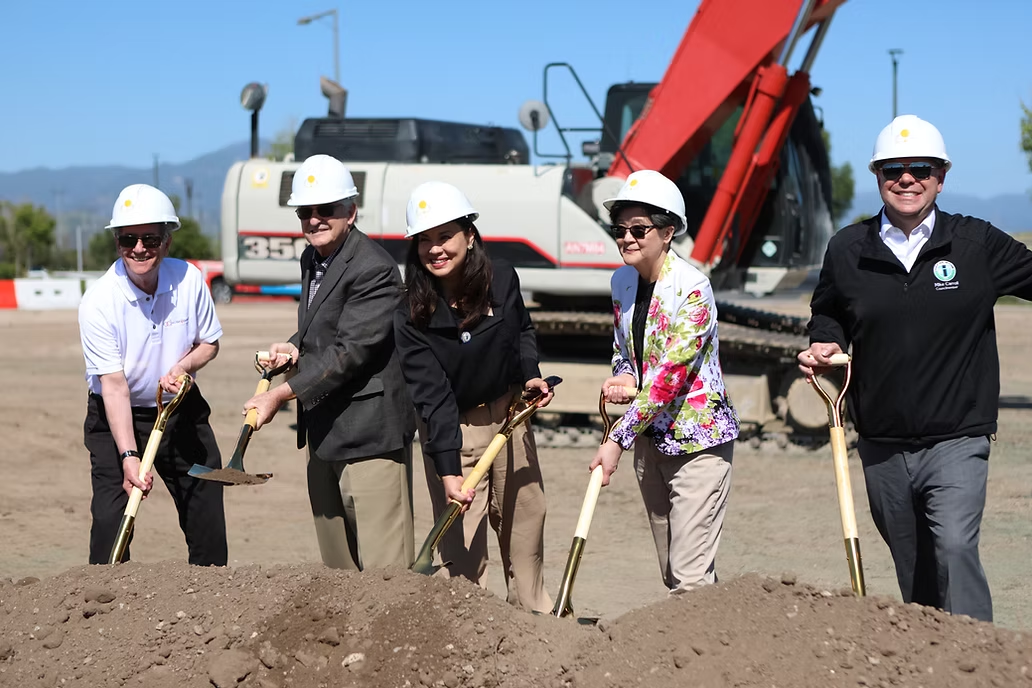
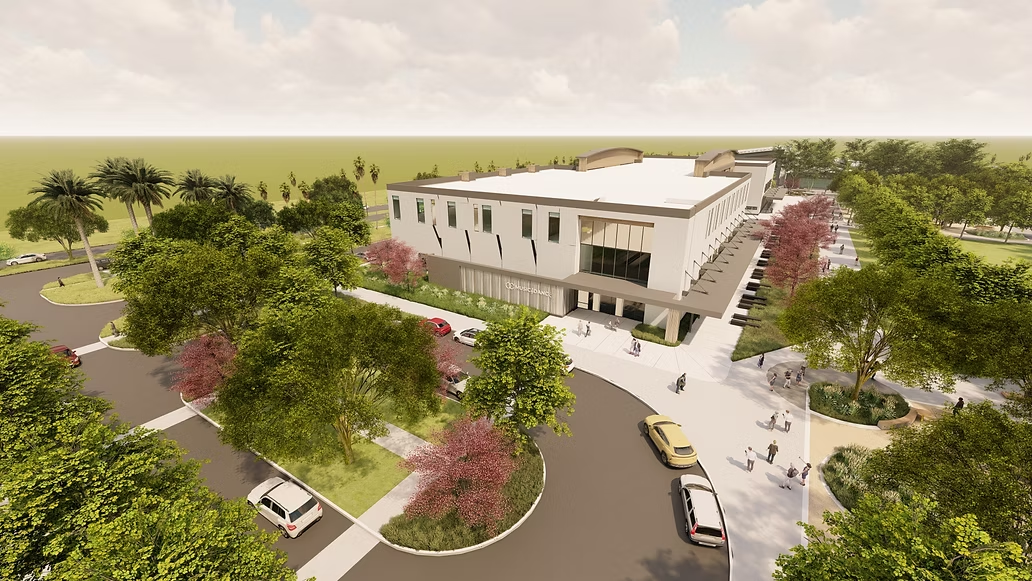
PHOTO 1: From left, OCMD CEO Doug Freeman, Irvine Councilmember Larry Agran, Councilmember Tammy Kim, executive director of South Coast Chinese Cultural Center Yulan Chung and Councilmember Mike Carroll at the groundbreaking ceremony in May 2024. Photo courtesy Orange County Music & Dance. PHOTO 2: A rendering of the facility planned for OCMD at the Great Park. Image courtesy of city of Irvine.
Construction delays changed the calculus
The Great Park occupies the former Marine Corps Air Station El Toro, a major U.S. military installation. Established during World War II, it was a crucial training base for pilots and a debarkation point for personnel deployed overseas. The base remained active through the Korean and Vietnam wars until its official closure in 1999. Ground and water pollution have been a significant concern due to the site’s history as a busy military aviation hub. The land was designated a Federal Superfund site by the Environmental Protection Agency in 1990.
In 2005, the Navy sold the decommissioned base to a private developer, Lennar Corp., for approximately $649.5 million. Under an agreement with the City of Irvine, Lennar immediately transferred 1,347 acres to the city specifically for use as a public park. It is managed by the Great Park Corporation, a nonprofit organization governed by the five sitting members of the Irvine City Council.
Remediation coordination between federal and state agencies, the Navy and the city of Irvine slowed the approval process, Freeman said. “It was always anticipated that the Navy would release (the Cultural Terrace) land to the city after the remediation on those parcels was completed. Three years ago, the city, the Navy, the DTSC (the Department of Toxic Substances Control, the state agency responsible for site cleanups) and the EPA agreed to the process of remediation. That work was effectively completed last year. Unfortunately, the final-step approvals from the agencies have not been granted, and no date … has been set for the approval.”
That delay greatly complicated OCMD’s plans to sell its present building to the City of Irvine and find a temporary space during construction. Its sale was crucial to financing the new Great Park complex.
“They were going to buy it at market value, and we had a $15.5 million agreement,” Freeman said. “But we never got close to (closing the deal), because we would have to leave by August of this year.”
That meant finding an interim space suitable for the school that would be occupied for at least 18 months, possibly much longer given the construction delays, Freeman noted. “So I’m on the road going from building to building, looking for places that are big enough to handle us.” That temporary space would have to accommodate many music studios, office space and rooms large and flexible enough for dance studios.
FACTBOX
Sidebar: Why Construction Costs Have Risen
Overall construction costs for commercial projects rose almost 10% in 2025.
Tariffs on core building materials have led to immediate price spikes and long-term volatility:
Steel and Aluminum: Section 232 tariffs, which were doubled to 50% in mid-2025 for most countries, have driven up costs for structural steel, rebar and ductwork. Domestic steel prices rose approximately 17% in 2025.
Lumber: Canadian softwood lumber remains a major cost driver, with duties recently fluctuating and potentially reaching nearly 40%, making framing significantly more expensive.
Other materials: Copper wire and cable prices jumped 22% year-over-year by early 2026 due to trade policy pressures. Other materials like drywall and kitchen cabinetry have also faced new or elevated tariffs.
Other costs have increased as well:
Persistent shortages of skilled trades such as electricians and plumbers have led to construction wage growth of 4.7%.
Sustained high borrowing costs have deterred some projects and increased financing expenses, which now account for a larger portion of total project budgets.
Tariffs have forced a shift toward local sourcing. While this reduces trade risk, it often introduces higher short-term costs as domestic suppliers ramp up capacity.
Sources: California Department of General Services, dgs.ca.gov; Cushman & Wakefield; Dodge Construction Network
Another looming problem was OCMD’s commitment to provide a space for the Title I high school, Ednovate, which would have occupied a significant part of the Great Park complex. Ednovate is a charter school consortium developed by the USC Rossier School of Education with several campuses in Los Angeles County. It needed to move into its new home by the beginning of the 2028-29 academic year. Freeman said it was becoming increasingly clear that the new structure would not be completed by then.
All these factors weighed on OCMD’s board of directors as they considered what to do. “We were in very good financial shape, I thought,” Freeman said. “We had raised over 60% of the construction costs. So the decision was, if we can’t be sure about the timeline, we need to rethink this.”
The present expansion timeline is much shorter. “We expect to complete the acquisition in 60 days, and we should be ready to open our doors in the new campus by September,” Freeman said.
Freeman pointed out that the combined square footage of the existing and soon-to-be acquired building will be roughly equal the size of the Great Park project. “When we realized that building had 25,000 square feet and met all of our programmatic requirements, we (would) be at 46,000 (total) square feet, which is what we were going to have at the Great Park (facility).” The two-story building has 85 dedicated parking spaces.
The decision also gives OCMD more financial freedom without sacrificing the quality of its programs, Freeman said. “Whether we’re here or in the Great Park, (students are) going to learn the same thing. And if we can do it here without any debt, why would we go there and have a $22 million loan?”
Another advantage of the new location is the availability of an adjacent church as a performance space, Freeman said.
“We were planning on creating at the Great Park a fairly large auditorium. We don’t have to do that now. The church has a sanctuary that can accommodate 600 people. We’ve already made an agreement with them.” The venue will be available on a continuing basis for OCMD concerts and events, Freeman said.

Decision had been building ‘for a while’
Ralph Opacic, who founded Orange County School of the Arts, is an OCMD board member, and he has served as the school’s strategic advisor since September. He said the decision to buy the nearby property came about as a result of searching for an interim home.
“We found the new building while we were looking for a temporary location. As I recall, the OCMD executive committee discussed this temporary location as a possible permanent site and made the recommendation to the board to explore its viability when it appeared we would not be moving forward at the Great Park.”
As one of the principal tenants of OCMD’s present facility, Pacific Symphony is a major stakeholder in its plans to expand. Pacific Symphony president John Forsyte, who also serves on the OCMD board, said the decision to abandon the Great Park project was regrettable in some ways but ultimately a sensible choice given changing conditions.
“I think it was a decision that had been building for a little while,” Forsyte said. “There was this opportunity to (secure) a building within proximity of our current venue. I think in combination with the potential delays and the economic challenge of the fundraising and avoiding a large loan, this is really a synergistic decision. I’m on the (OCMD) board and we’re also a tenant, so I wear two hats and I try to speak from both perspectives. Doug and Charlie (entrepreneur and philanthropist Charlie Zhang, who founded OCMD) had done such an amazing job with fundraising. I had sadness for them because they had worked on (the Great Park project) for several years running. But this is the right decision.”
Forsyte sees other upsides to OCMD’s new plans to expand in its present neighborhood.
“Right now, we’re not far from the Segerstrom Center for the Arts (the performance home of Pacific Symphony). That would have been the downside of moving to the Great Park. It’s further away. I think our staff is also relieved that they don’t have to make two moves.”
Forsyte remains grateful for Irvine’s partnership with the symphony in the construction of a new outdoor amphitheater in a different part of the Great Park. “We remain fully committed to that project.”


Aerial views of the land set aside for the Cultural Terrace. The photo taken on May 31, 1995 by the U.S. Geological Survey shows the Marine Corps Air Station El Toro buildings that existed in this location. The satellite view taken on Oct. 4, 2025 shows the extent of the land cleared in preparation for construction. Photos courtesy of Google Earth Pro

Other stakeholders were largely mum about the change of plans or cautious in their assessments. “I feel it is the best move for OCMD to seek this alternative path that it has,” said OCMD board member Patrick Brien, president and CEO of Arts Orange County. “(We have) been a tenant in the current building since it was built, and we are happy remaining in this central location.”
The withdrawal of Orange County Music & Dance has left a significant gap in the Cultural Terrace master plan. The city of Irvine has not yet officially designated a replacement for the OCMD site, and the sudden absence in the 45-acre museum district has put additional pressure on the remaining projects.
The Pretend City Children’s Museum continues as a major partner, but shifting blueprints and ballooning construction costs will present significant challenges for the project. The Flying Leatherneck Aviation Museum remains a core component of the terrace, with site work ongoing. The Asian American Museum is still listed as a future partner.
The city of Irvine spent $91 million to prepare the land at the Great Park Cultural Terrace. This included grading, demolition and the installation of core utilities and infrastructure to make the site ready for OCMD’s 70,000-square-foot campus. Combined with a $1-per-year ground lease to OCMD for 50 years, this investment is one of the largest municipal gifts to a nonprofit in the U.S. The city’s land preparation costs were part of the broader $1.2 billion Great Park development budget, funded primarily through Mello-Roos taxes from local homeowners and city bonds.
“The site work is recoverable and transferable,” said Irvine councilmember William Go, who is chairman of the Great Park Board. “I don’t think we’ve lost anything in terms of financials. Whoever (builds on the former OCMD site) will be able to use what we’ve done.”
Go said that the kind of delays OCMD experienced with the Cultural Terrace project aren’t uncommon for the Great Park. “Most of our partners are maybe not used to the back and forth and uncertainty of the Great Park. There are all these contingencies involved with the EPA (and other agencies). Everything takes time.” But he understood the reasoning behind OCMD’s decision. “It just got to the point where the uncertainties were too much to overcome.”
Go said he left the door open for a future OC Music & Dance project somewhere in the Great Park. “I told Doug (Freeman) and Charlie (Zhang), ‘If you still want to do this some day, we’ve got plenty of land in the Great Park.’” Go mentioned other groups are exploring a presence in the Cultural Terrace. “I spoke to (representatives of) the Discovery Cube. They have an interest in it. They have two locations and aren’t opposed to having a third. They know that Irvine is a great place for STEM.”
Go thinks OCMD’s change of plans reflects a bigger change in the economy that will affect how the park is developed as well. “The challenge we have is that the financial markets aren’t easy right now. Interest rates are high. And the city doesn’t have unlimited funds. We’re already building a billion dollar park. We’ve got to be smart with our resources.”
That means being willing to explore new possibilities for the Cultural Terrace. “I would be open to anything there. A library, a mixed-use housing development. Times have changed and we’ve got to be open to how everyone’s adapting to how life is being lived now.”
Opacic said regardless of the expanded school’s location, OCMD plays a vital role in local arts education.
“OCMD is positioned to not only be a feeder to programs like the Orange County School of the Arts, but could also be a viable alternative to receive high quality college preparatory experience in the arts for the thousands of students OCSA turns away each year,” he said. “OCMD’s growth is currently limited by its facilities. Having expanded facilities will provide the space needed to expand programs and serve a greater number of students.”
Douglas K. Freeman, John Forsyte and Patrick Brien, quoted in this story, are members of the Culture OC advisory board.
Related Stories
 Bei Bei Bridges the Divide Between Traditional and Modern Music
 Shelley, the Pacific Symphony and Pacific Chorale Resurrect Mahler 2
 OC Arts Awards Recognize 26 Years of Creativity and Community
 Shelley Debuts as Pacific Symphony’s Music Director
Recent Stories
Bei Bei Bridges the Divide Between Traditional and Modern Music Curtains Up for Cinematic Celebrations: Your Guide to Orange County’s 2026 Fall Film Festivals
 When It Comes to Censorship, Who Gets to Wield the Eraser?
 Orange County Celebrity Chefs and Health-Conscious Founders This Month on ‘Walk-Ins Welcome’
At Culture OC, our mission is to engage with a diverse range of Orange County’s artistic and cultural communities at every level by publishing news and critical analysis to encourage interest, participation, fellowship and dialogue.